sysume
FULL STACK · AI ENGINEER
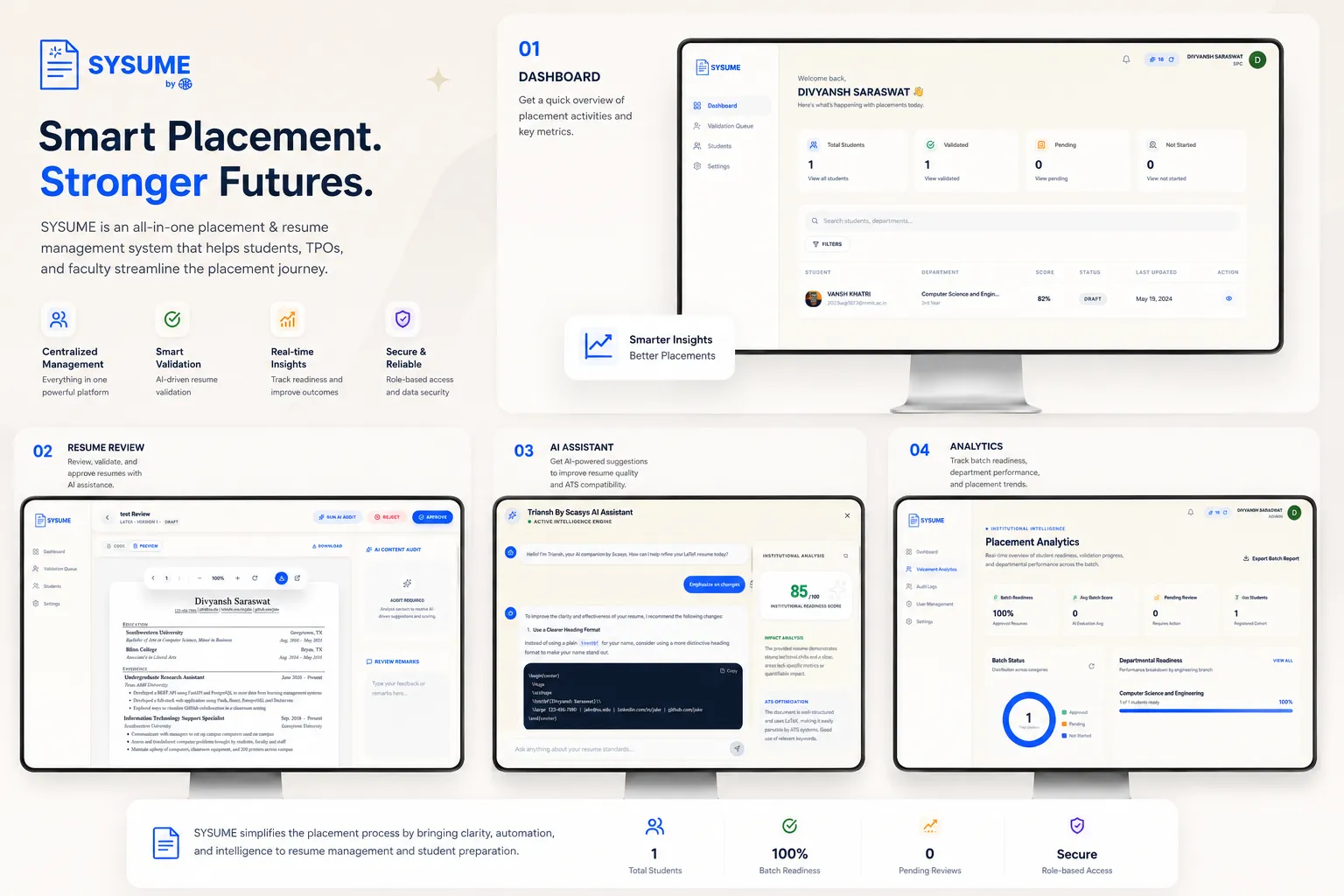
On the surface, a placement management system for MNIT. One layer deeper, a resume-intelligence platform where LaTeX is the source of truth, AI is the co-author and human reviewers are the final authority. The full pipeline is real and connected — student writes LaTeX → AI scores and improves → faculty validates → PDF is approved → student goes to placement. Not a prototype, not a mockup.
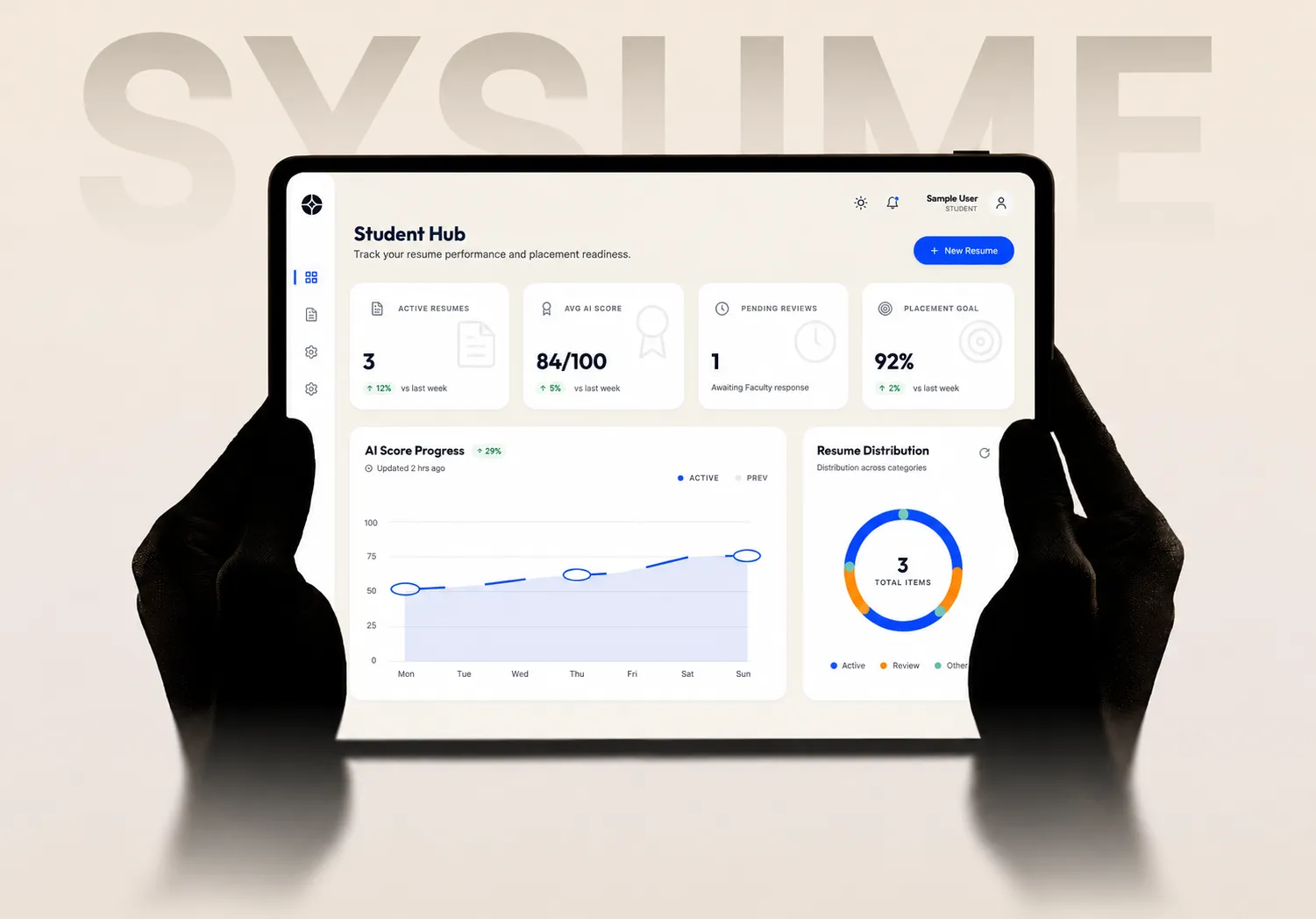
A student in placement season is under enormous cognitive load — academics, interview prep, competitive coding and anxiety, all at once. They don't want to learn a new system; they want to feel progress, get useful feedback, and know exactly where they stand. So the student dashboard is card-based and status-driven: every resume shows type, AI score and approval status at a glance, with Edit/Submit always visible. The editor follows the Overleaf mental model — code left, preview right — because you leverage muscle memory, you don't fight it.
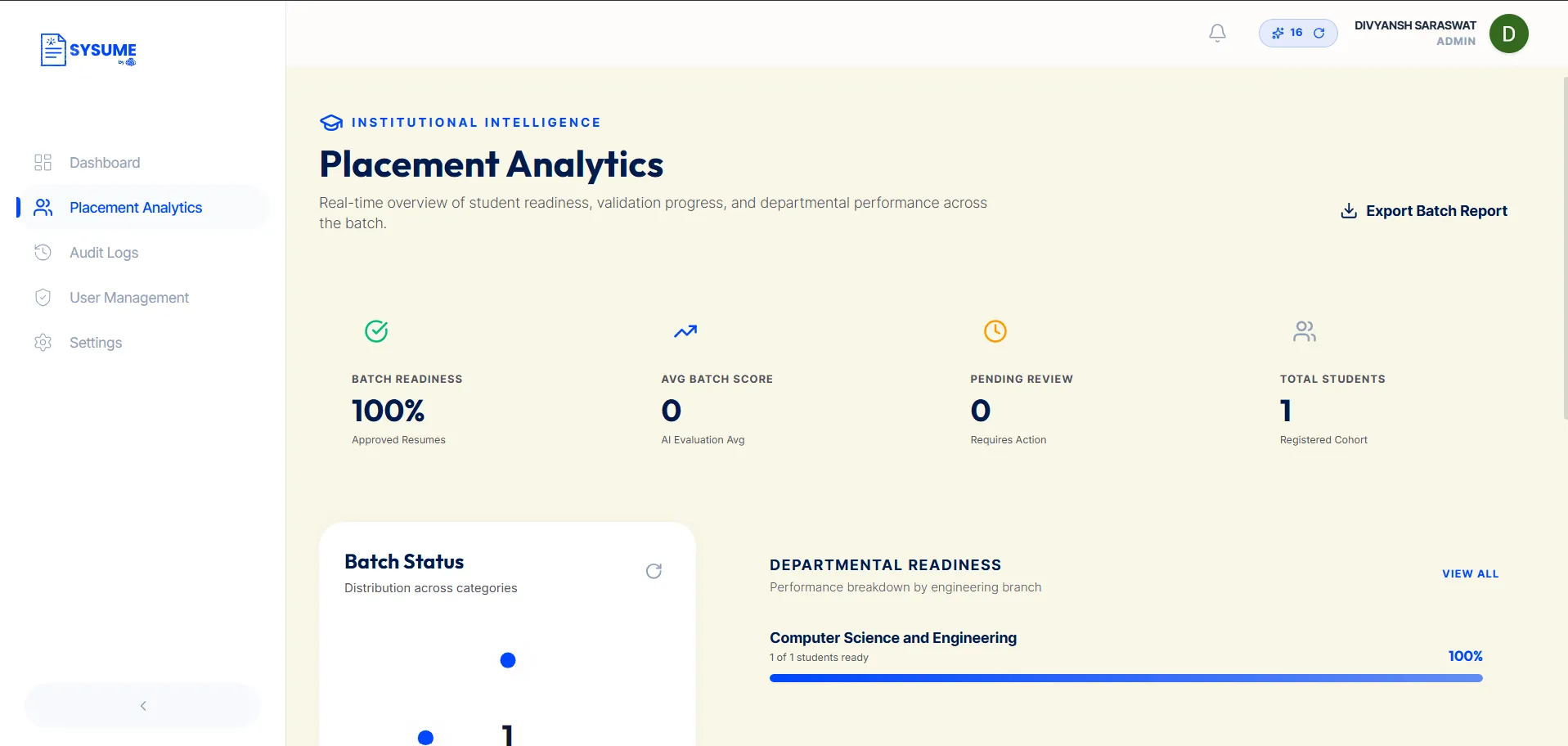
Faculty review dozens of resumes alongside a full teaching load, so they get table-first, action-fast UX: a sortable, filterable table with approve/reject in a modal that shows the PDF preview and AI score side by side — one decision, one click, logged permanently. Admins care about the macro picture, so they get analytics and a complete audit trail: every action (who approved what, when, with what remarks) lands in a dedicated MongoDB collection as a first-class feature, not an afterthought.
The AI — named Triansh — is positioned carefully: it doesn't write the resume, it improves what's already there. The chat streams token-by-token and has deep context of the student's current LaTeX, so 'make this bullet stronger' returns actual LaTeX snippets, not generic text. Generic feedback is explicitly forbidden — instead of 'your experience is good' it must say 'add a quantifiable metric: reduced processing time 30% using Redis caching'. A knowledgeable senior reviewing your draft — trust without dependency.
The visual language draws from three references: Overleaf (split-pane code-left/output-right), Notion (calm dark surfaces with room to breathe) and the Stripe dashboard (data-dense but never cluttered, status badges everywhere). Dark-mode default on deep navy (#0F172A) with an indigo primary (#4F46E5) that reads intelligent and technical without being cold. Inter for UI, JetBrains Mono in the editor. The most loaded color is the success green — when a resume turns Approved, it means something real to the student.
MongoDB was chosen for schema flexibility and its async Motor driver. Resume versions are embedded inside the resume document — full history in one query, no joins — each version carrying its LaTeX code, PDF url, status and AI score (overall, ATS, suggestions). The key decision: the .tex file is stored, versioned and AI-edited; the PDF is generated on demand. That means the system can recompile at any time, apply AI changes to the actual source, and produce readable code diffs between versions. Status is a strict lifecycle: draft → submitted → approved/rejected, superadmin override always logged.
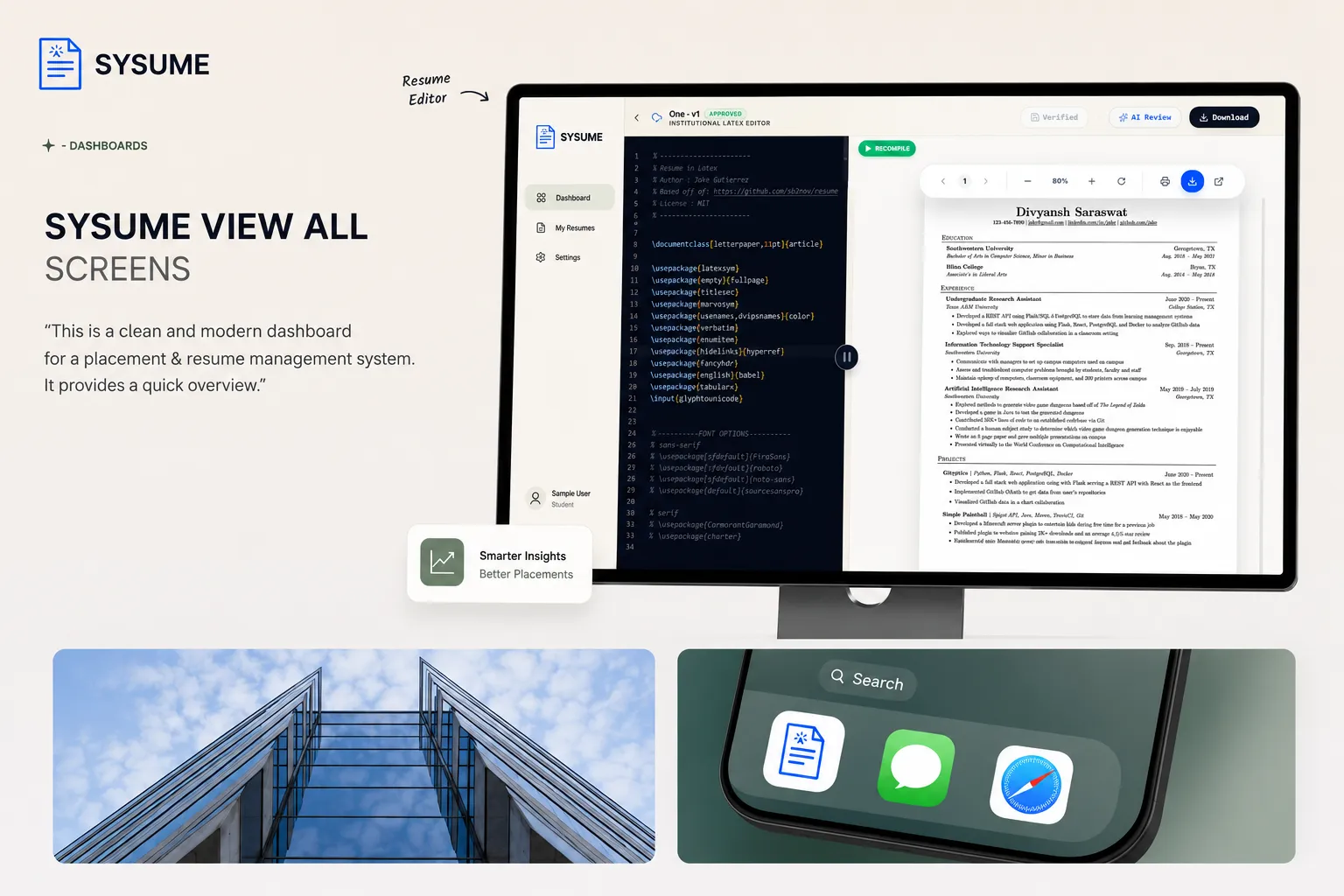
LaTeX compilation is CPU-intensive (2–8s), blocking, user-controlled and multi-user — calling pdflatex synchronously per request would pin the CPU, block the event loop and give zero feedback. The solution is a two-worker asyncio queue with WebSocket status push: a job returns immediately with its queue position, the client opens /ws/latex/{job_id}, a worker runs pdflatex in asyncio.to_thread (works on Windows MiKTeX and Linux TeX Live alike), and the user watches 'You are #3 in queue → Compiling → Done ✅' — a technical wait turned into a transparent Overleaf-like experience.
Compilation is switchable via env: local pdflatex or the texapi.ovh REST API for TeX-less deploys. The local path runs with -no-shell-escape (non-negotiable — it blocks \write18{rm -rf /} injection via LaTeX macros) inside isolated /tmp directories cleaned up after use. AI output is passed through make_latex_safe() before return, escaping bare &, %, $, #, _ and braces that models occasionally emit and which would otherwise break compilation on every improved bullet.
A provider-agnostic singleton switches between Groq (fast Llama inference) and OpenRouter (reasoning-enabled) on one env var, both implementing the OpenAI contract so client code is identical. System prompts live as tunable Markdown files, not hardcoded — the scoring prompt enforces strict mode (a score above 90 is 'extremely rare, reserved for world-class resumes') to kill grade inflation, and the chat prompt injects the student's current LaTeX directly so Triansh references real commands and formatting rather than a generic document.
The Next.js frontend is four purpose-built role experiences — student editor, faculty/SPC validation, admin users and logs — reflected in the routing. The editor is the key screen: Monaco (the VS Code engine) for the LaTeX pane, an iframe PDF preview, and a slide-in AI drawer. Monaco was lazy-loaded from day one — its 3.5MB bundle was adding 6s to first load, so dynamic import with ssr:false keeps the landing untouched. Auth was consolidated into a single root AuthContext, killing a duplicate /auth/me call, with Google SSO restricted to @mnit.ac.in at the API layer.
Most college placement tools are glorified spreadsheets with PDF upload. This is different in three ways: LaTeX is the canonical format, so AI edits real document structure and version diffs are readable code; the AI is context-aware, carrying the full .tex in its window and enforcing STAR/XYZ with calibrated, inflation-resistant scoring; and the compile pipeline is genuinely real-time — a LaTeX error on line 42 surfaces in the UI immediately from the pdflatex log, not a spinner that might be stuck. The goal is simple: a student leaves with a better resume and more confidence than when they arrived.